Looking for something?
Use the form below to search the site:
Still not finding what you're looking for? Drop a comment on a post or contact us so we can
take care of it!
ABOUT William C Andersen
The William C. Andersen Award was established in 1982 in memory of Bill Andersen, who drowned in 1980 while canoeing the Churchill River in Manitoba during a Peregrine Falcon survey. Dr. Andersen was a chemistry professor, but his first love was raptors. He established the Ornithology Research Center at Otero Jr. College in La Junta Colorado, as a medium for raising funds for the field research he conducted with his students. His interest in raptors of southeastern Colorado grasslands naturally evolved into developing a solution to the universal problem of raptor persecution. He established a rehabilitation facility and tirelessly lectured to service clubs and school groups about the benefits of raptors. He was a strong supporter of the RRF and a number of students accompanied him to each of the annual meetings. His enthusiasm, sincerity, and humor sparked an interest in raptors among many of his students and associates. While participating in the 1980 North American Peregrine Falcon Survey, Bill and a partner were canoeing on the Churchill River in northern Manitoba. They unexpectedly encountered extremely turbulent water and capsized. Bill disappeared and presumably drowned. In that instant, raptors and raptorphiles lost one of their strongest allies.
THE AWARD
The William C. Andersen Memorial Award is given to both the best student oral and poster presentation at the annual RRF meeting. This award can only be given to a student once per degree (bachelor, master, or doctorate). To be eligible, a student must be senior author and presenter of the paper or poster. If less than 5 posters are in contention, no separate poster award will be given. Information on how to prepare and give a scientific presentation and criteria used to judge the presentations are available from the committee chair. Award recipients will be announced at the banquet. Students wishing to apply for this award should indicate their interest by checking the box on the abstract submission form.
In addition, students planning to present a paper should submit a second extended abstract to the Andersen Award Committee. The extended abstract should be a maximum of 3 pages double spaced, in JRR format. The purpose is to provide a clear background/context for the study, methods used, results, and relevancy of findings. The Andersen Committee will judge the extended abstracts for quality and select the 8 best papers to be presented as 15 min presentations during a single Andersen Award paper session on Thursday. The paper cannot be part of an organized symposium to be considered.
Amount:
Poster award receives $100, a banquet ticket, and 1 year free membership to RRF
Paper award receives $300, a banquet ticket, and 1 year free membership to RRF
Number of Awards Issued per Year: 1 paper and 1 poster awardee
Deadline: Due date for meeting abstract form
Contact: Clint Boal, USGS Texas Cooperative Fish and Wildlife Research Unit, Department of Natural Resources Management, 218 Agriculture Sciences, Texas Tech University, Lubbock, TX 79409-2120, Phone: (806) 742-2851 clint.boal@ttu.edu

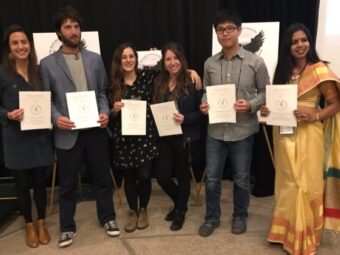
RRF 2010 Student Award Winners, L - R: Elizabeth Wommack (Winner, Andersen award for best student poster); Chris Briggs (Honorable mention, Andersen award for best student poster); Joe Barnes (Winner, Andersen Award for best student paper); Jessi Brown (Honorable mention, Andersen award for best student paper). Dan Varland photo.
Award Recipients:
| Year | Paper Recipient | Title |
| 2011 | Tricia Miller | Striking a balance: modeling migration of Golden Eagles through wind energy developments of the central Appalachian Mountains. |
| 2010 | Joseph Barnes | Call-Broadcast Surveys as an Effective Tool for Detecting Breeding Peregrine Falcons (Falco peregrinus) |
| 2009 | Chris Briggs | Testing the heterozygote advantage: population parameters and morph in Swainson’s Hawks |
| 2008 | Isable Caballero | Genetic Analysis Reveals Possible Extra-pair Paternity and Sex-biased Dispersal in an Urban Avian Predator (Falco peregrinus) |
| 2008 | James Dwyer | Interpecific and Intraspecific Social Interactions of Crested Caracaras (Caracara cheriway) in Florida |
| 2007 | Markus Mika | Population genetics and evolutionary history of the Flammulated Owl (Otus flammeolus) |
| 2006 | Emile Berthiaume | Should Detectability Be Included in Hawk Count Population Trend Analyses? |
| 2005 | Timothy C. Roth II | “Diet, activity patterns, and predictability of movement of wintering Accipiter hawks” |
| 2004 | Diego Sustaita | An anatomical comparison of the hindlimb and jaw of North American hawks and falcons in relation to prey procurement |
| 2003 | Joshua Hull | Historical demography and population genetic structure of migrating Sharp-shinned Hawks |
| 2002 | Unknown | |
| 2001 | Ryan Brady | Effects of mammalian dung on predation of Burrowing Owl nests |
| 2000 | Unknown | |
| 1999 | Chad Olson | “Hawk shooting, not just a problem of the past” |
| 1998 | Brian W. Smith | Effects of chamber size and tunnel diameter on use of artificial nest burrows by Burrowing Owls |
| 1997 | Kim J. Fernie | Electromagnetic field exposure affects American Kestrels: an explanation |
| 1996 | Unknown | |
| 1995 | Andrew King | Effects of experimental food addition on the post-fledging movements of Burrowing Owls in southwestern Idaho |
| 1994 | Johanna M. Ward | Effects of experimental food addition on the reproductive ecology of the Northern Goshawk during brood rearing |
| 1993 | Unknown | |
| 1992 | Kennedy Chandler | |
| 1992 | Laura Beatriz Rivera-Rodriguez | |
| 1991 | D. Plumpton | |
| 1990 | J. Timothy Kimmel | |
| 1989 | Gustavo Danemann | |
| 1988 | Unknown | |
| 1987 | Thomas Hamer | |
| 1982 | Jimmie R. Parrish | Identification of peregrine falcon natal locales by trace element analysis of feathers. |
| Year | Poster Recipient | Title |
| 2011 | Ben Skipper | Comparison of reproductive performance of exurban and urban Mississippi Kites. |
| 2010 | Elizabeth Wommack | Examination of Clinal Patterns of Black and White Tail Coloration for male American Kestrels (Falco sparverius) across the North American Continent |
| 2009 | Stefan Schindler | “Population trends and management scenarios for the diverse raptor community of Dadia National Park, Greece” |
| 2008 | Travis Booms | Molted Raptor Feather Persistence and aging in a Sub-Arctic Environment: Implications for Non-invasive Genetic Sampling |
| 2007 | Not awarded | |
| 2006 | Not awarded | |
| 2005 | Not awarded | |
| 2004 | Corey Riding | Effects of nest cleanliness on burrow re-use by Burrowing Owls |
| 2003 | Not awarded | |
| 2002 | Unknown | |
| 2001 | Not awarded | |
| 2000 | Unknown | |
| 1999 | Brian Smith | “Ecoparasites on Burrowing Owls: potential effects on nest site re-use and growth, body condition and survival of juveniles” |
| 1998 | Pamela Freeman | Analysis of variation in Barred Owl hooting calls |
| 1997 | Brian L. Herting | Testosterone-induced variation in the vocalizations of male Western Screech Owls |
| 1996 | Unknown | |
| 1995 | Unknown | |
| 1994 | Andrea Erichson | Communal roosts: seasonal dynamics of a White-shouldered Kite population in the Sacramento Valley |